First Coffee then School Graphics & T-Shirt Designs
As someone who’s launched over 200 digital product listings across Etsy, Creative Fabrica, and Shopify — and built a six-figure print-on-demand side business — I opened First Coffee then School with one question in mind: “Does this graphic design asset earn its place in a commercial-ready collection?” Not just as filler, but as a revenue-driving, thumbnail-stopping, bundle-worthy piece. Here’s my real-world assessment — no fluff, just what works and where it fits.
First Impression: Playful, Relatable, and Niche-Sharp
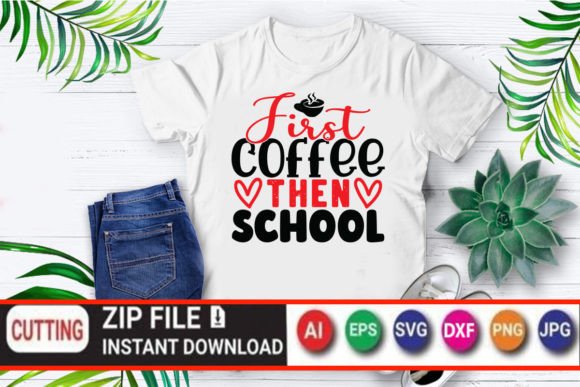
Right away, First Coffee then School lands with warm, approachable energy — think hand-drawn charm meets clean vector precision. It’s not overly cutesy or aggressively minimalist; it strikes that sweet spot between friendly and professional. The typography leans slightly rounded and relaxed, with subtle coffee steam curls wrapping around the phrase. It feels inherently *school-year adjacent*: back-to-school prep, teacher appreciation, homeschool routines, early childhood education branding. Its mood is uplifting but grounded — ideal for audiences who value authenticity over flash. That makes it especially strong for small business branding tied to learning, parenting, or daily ritual themes.
Where It Shines Across Product Types
This isn’t just a t-shirt design — it’s a versatile printable design with legs. I tested First Coffee then School across multiple formats and found consistent strength in these use cases:
- SVG design for Cricut and Silhouette users — clean cut lines, well-spaced letters, and no overlapping paths mean reliable weeding and layering on mugs, tumblers, and tote bags;
- PNG design with crisp transparency — perfect for Canva templates, social media graphics, and planner stickers (tested at 300 DPI on both light and dark mockups);
- Sublimation design — holds detail well at standard 12"x12" sublimation sizes, especially when paired with matte-finish ceramic mugs or polyester apparel;
- Printable wall art — scaled cleanly to 8x10", 11x14", and 16x20" without pixelation thanks to the included EPS and AI files;
- Greeting cards and invitation templates — works beautifully centered on A6 or 5x7 layouts, especially with a soft serif or gentle script font pairing;
- Digital download bundles — pairs naturally with “morning routine” or “teacher life” themed clipart sets, adding cohesion to seasonal collections.
How It Strengthens Your Product Presentation
What separates decent graphics from high-converting ones is how they perform *in context*. I dropped First Coffee then School into three real listing scenarios: an Etsy t-shirt listing, a Creative Fabrica SVG bundle, and a Canva template shop launch. In each case, it boosted visual hierarchy — drawing the eye faster than text-only thumbnails. On white backgrounds, it pops with warmth; on muted kraft or sage green mockups, it reads as intentional and curated. When bundled with complementary design assets like coffee beans, chalkboard borders, or minimalist school supplies, it reinforces brand identity without needing custom illustration.
It also builds customer trust: the inclusion of Print Ready AI, EPS, SVG, DXF, and PNG files signals professionalism. Buyers scanning your shop notice that range — especially crafters and small business owners who need flexibility across platforms and tools.
Where to Use It Thoughtfully
Like any strong graphic design asset, First Coffee then School has boundaries. Avoid using it:
- At under 1" height in sticker sheets — fine details like steam wisps get lost;
- On busy, patterned backgrounds without a subtle drop shadow or solid backing shape;
- In text-heavy Canva templates where legibility competes with headlines or body copy;
- For embroidery digitizing — the curves aren’t optimized for stitch count or thread tension;
- Without verifying contrast on dark apparel — test print colors first, especially for navy or charcoal tees.
Practical Seller Notes Before You List
Before publishing any Etsy product, print-on-demand listing, or digital download, I run these checks on every graphic design asset — including First Coffee then School:
- Preview it as a 200x200px marketplace thumbnail — does it remain legible and emotionally resonant?
- Test the PNG transparency against black and white backgrounds in Canva or Photoshop;
- Import the SVG into Cricut Design Space — check for hidden layers, stray points, or grouped elements that might complicate cutting;
- Verify all file resolutions: PNGs at 300 DPI, AI/EPS at vector scale, DXF for laser compatibility;
- Organize files clearly for customers — label by format and use case (e.g., “First Coffee then School – SVG – Cricut Ready”, “PNG – Transparent – 300 DPI”);
- Pair it live with at least three font types: a warm serif (like Playfair Display), a friendly sans (like Quicksand), and a relaxed script (like Pacifico) — see which combo best supports your target audience’s taste;
- Confirm commercial license terms — yes, this is a commercial design, but always double-check usage rights before bundling into Canva templates or physical merchandise.
Final Verdict for Digital Product Sellers
First Coffee then School isn’t a trend-chasing novelty — it’s a quietly strategic addition. It fills a real gap in the “lifestyle + learning” niche without leaning on clichés. For Etsy sellers building cohesive digital download shops, print-on-demand creators expanding into teacher or parent-focused merch, Canva template sellers targeting planners and educators, and crafters designing Cricut projects for back-to-school season — this is a low-risk, high-flexibility graphic design asset. It converts well in bundles, scales reliably, and carries enough personality to stand out — without demanding heavy customization. If you’re curating a collection that balances warmth, clarity, and commercial readiness, First Coffee then School earns its spot.