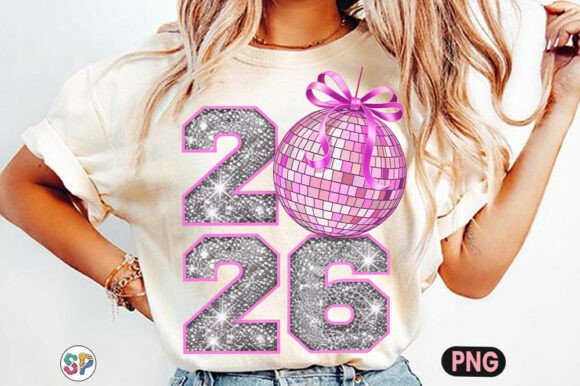
New Year 2026 Disco Ball Glitter PNG
First Impressions: Sparkle with Purpose, Not Just Pixels
Opening New Year 2026 Disco Ball Glitter PNG feels like unboxing a party favor—vibrant, playful, and instantly nostalgic. At 4500×5400 px and 300 DPI, the file delivers crisp edges and smooth gradients, but as an embroidery designer, I don’t stop at resolution. I ask: *Will this translate into clean, stable stitches?* The circular disco ball motif is bold and centered, with radiating glitter bursts that suggest movement and celebration. It’s not overly intricate—no micro-details or fragile linework—but it’s also not flat. There’s subtle layering in the highlights, giving it dimension without crossing into “embroidery-unfriendly” territory. For a T-Shirt Designs asset, it strikes a rare balance: festive enough for holiday merchandise, clean enough for boutique branding, and scalable enough to hold up on both a toddler onesie and a linen tote bag.
A Real-World Test: Embroidering This on a Cotton-Linen Blend Tote
Last week, I prepped New Year 2026 Disco Ball Glitter PNG for a custom embroidered tote bag—part of a small-batch New Year collection for a local gift shop. I converted it to a machine embroidery design using vector tracing (since only the PNG is provided), then digitized with moderate stitch density: satin stitch for the outer ring, fill stitch for the central ball, and short running stitches for the glitter rays. On medium-weight cotton-linen, it stitched cleanly at 4.5" wide. Customers loved the tactile shimmer—not from actual glitter thread (which can shed), but from well-placed satin reflections and strategic underlay. That said, I’d avoid stitching it larger than 5.5" on lightweight fabrics; the fill areas gain weight quickly, and the design’s visual impact starts to blur if stretched too far.
Where It Shines—and Where It Needs Guardrails
New Year 2026 Disco Ball Glitter PNG works beautifully for:
- Sweatshirt embroidery — especially on charcoal or navy fleece, where the contrast makes the “glitter” pop without needing metallic thread
- Embroidered patch backing for holiday-themed apparel lines or craft fair merch
- Baby embroidery on organic cotton onesies (scaled to 3") — soft, joyful, and age-appropriate without being cutesy
- Holiday embroidery on tea towels and pillow covers, where its graphic clarity reads well even after multiple washes
- Commercial embroidery for Etsy sellers launching limited-run New Year bundles — it’s distinctive but not so niche it limits resale appeal
Use caution with:
- Stretchy fabric — the symmetrical shape pulls easily; always pair with cutaway stabilizer and test tension first
- Dark fabric + light thread — the PNG’s bright highlights don’t auto-translate to thread brightness; preview in grayscale mockups to avoid muddy results
- Curved surfaces like caps — the round shape helps, but tight crowns compress detail; reduce size to 3.25" and simplify outer rays if needed
- Thin or sheer fabrics — dense fill areas may show through; consider a lighter fill stitch density or switch to applique design logic for the center ball
What This Design Says About Your Handmade Product
Your customers don’t see a PNG file—they feel the intention behind it. New Year 2026 Disco Ball Glitter PNG carries energy and polish. When stitched well, it elevates a simple sweatshirt into a personalized gift, a kitchen towel into a curated hostess present, or a baby onesie into a keepsake. It supports brand consistency for craft businesses because it’s cohesive—not competing with typography or secondary graphics—and it reads clearly in digital previews (printable mockups) and physical displays alike. But here’s the quiet truth: its success hinges entirely on execution. A rushed digitization, mismatched thread colors, or skipped stabilizer testing turns sparkle into stiffness. That’s why I treat every digital embroidery file like a collaborator—not just a decoration.
Practical Notes Every Embroidery Designer Should Run Through
Before cutting fabric or loading your hoop:
- Test on scrap fabric — especially if using textured weaves or blends
- Check thread color contrast — try matte black, silver, and heather grey against your base fabric
- Review stitch density — high-density fills trap heat; reduce if embroidering on synthetics or baby items
- Confirm hoop size compatibility — this design fits comfortably in a 5×7 hoop, but verify before digitizing
- Inspect small details — those glitter rays are delicate; ensure they’re at least 0.8 mm wide post-digitization
- Test black-and-white mockups — helps spot tonal flattening before stitching
- Compare light/dark backgrounds — what reads as “glitter” on white may vanish on black without reflective thread
- Use proper stabilizer — medium-weight cutaway for knits, tear-away for stable wovens
- Verify licensing — since this is a Graphics file sold as a PNG, confirm commercial use rights before selling finished products or bundling into digital kits
Final Thought: A Design That Celebrates—Without Asking Too Much
New Year 2026 Disco Ball Glitter PNG isn’t trying to be everything. It’s a focused, joyful, commercially smart asset—ideal for craft businesses building seasonal collections, Etsy sellers refreshing their custom apparel offerings, or designers crafting limited-edition holiday embroidery. It doesn’t demand specialty threads or advanced techniques, yet it rewards thoughtful execution. In a market flooded with overcomplicated motifs, its clarity feels like a breath of fresh air—and that’s exactly what makes it a keeper in my design assets library.